
A New Way to Navigate the Human Side of Scaling in Life Sciences
Over the years, we’ve sat in many rooms with life sciences leaders. Rooms where teams were racing to build new facilities or develop breakthrough drugs while timelines tightened and uncertainty remained high. Rooms where the energy of a startup was beginning to collide with the discipline required for growth. Rooms where leaders quietly wondered whether the culture that fueled early innovation could survive the demands of scale.
As the science advances, milestones are met, and operations mature, something else is happening inside the organization—something far more human, far more emotional, and far more determinative of longterm success. People are navigating uncertainty, pressure, transition, and growth all at once.
The science might be moving fast, but it demands the people move faster, and culture bends under this speed. Employees are rarely upset by the work itself - they struggle with how the organization handles uncertainty, pressure, and transition.
Through our 30 years partnering with Life Science organizations, from discovery to discipline, we’ve noticed the strain leaders feel during growth is not random - it is predictable.
Every growth curve has a natural lifespan. What once worked beautifully eventually starts to strain under new complexity, scale, or regulatory pressure.
During these periods, ambiguity and pressure peak. Energy disperses. Communication gets heavier. Decisions slow down. Misalignment weighs on teams. The air just feels different. By the time the problem feels obvious, the culture has often already absorbed weeks or months of pressure.
The messy middles of scale—those uncomfortable spaces of ambiguity between what worked before and what is required next—follow patterns. The organizations that thrive aren’t the ones that just push harder. They’re the ones that evolve deliberately.
Introducing a New Model
Today, we’re introducing a model designed to finally make these human patterns of scaling visible—not just in what gets built, but in what people experience along the way. It reflects the messy middles leaders are living in, like:
Introducing structure without losing agility
Shifting teams from “figuring it out” to “getting it right”
Onboarding new hires into environments that are still forming beneath them
Watching cultures that felt strong early on strain under scale and scrutiny
While the messy middles of jumping curves are unavoidable, suffering through it is not. This model provides a way of seeing, and therefore leading, more clearly - so leaders can proactively recognize when and how to evolve intentionally, rather than reactively, before workforce strain turns to risk. It allows leaders to:
Anticipate when, where and why messy middle tensions will emerge
Understand what people are experiencing beneath the surface
Learn when and how to jump the curve while leading the workforce along the way
Growth is never just about capacity. It is about who you must become to carry it. And at every stage, something must be built — and something must be let go.
This model reframes growth not as a series of crises, but as a series of normal, expected messy middles—each with its own human signals, risks, and leadership moves to effectively jump the curve to your next stage of growth.
When leaders can recognize these early signals, they can evolve the system proactively—before friction turns into decline.
Understanding the Model
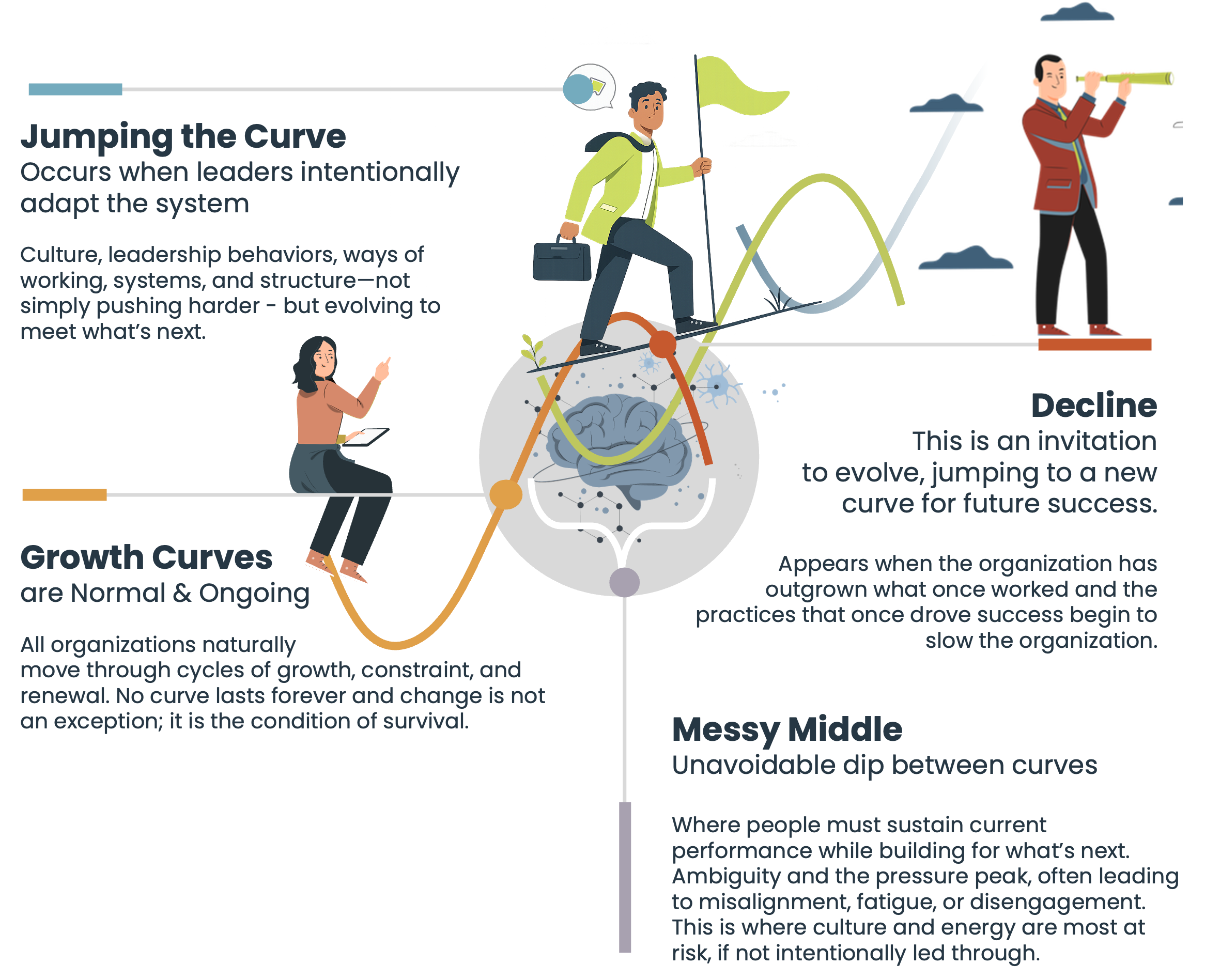
The Continuum Jump Model Stages
This model zooms out to focus on the organizational journey from startup to scale, where leaders must navigate not just technical milestones, but the cumulative human impact of sustained uncertainty, pressure, and change. It consists of 5 stages:
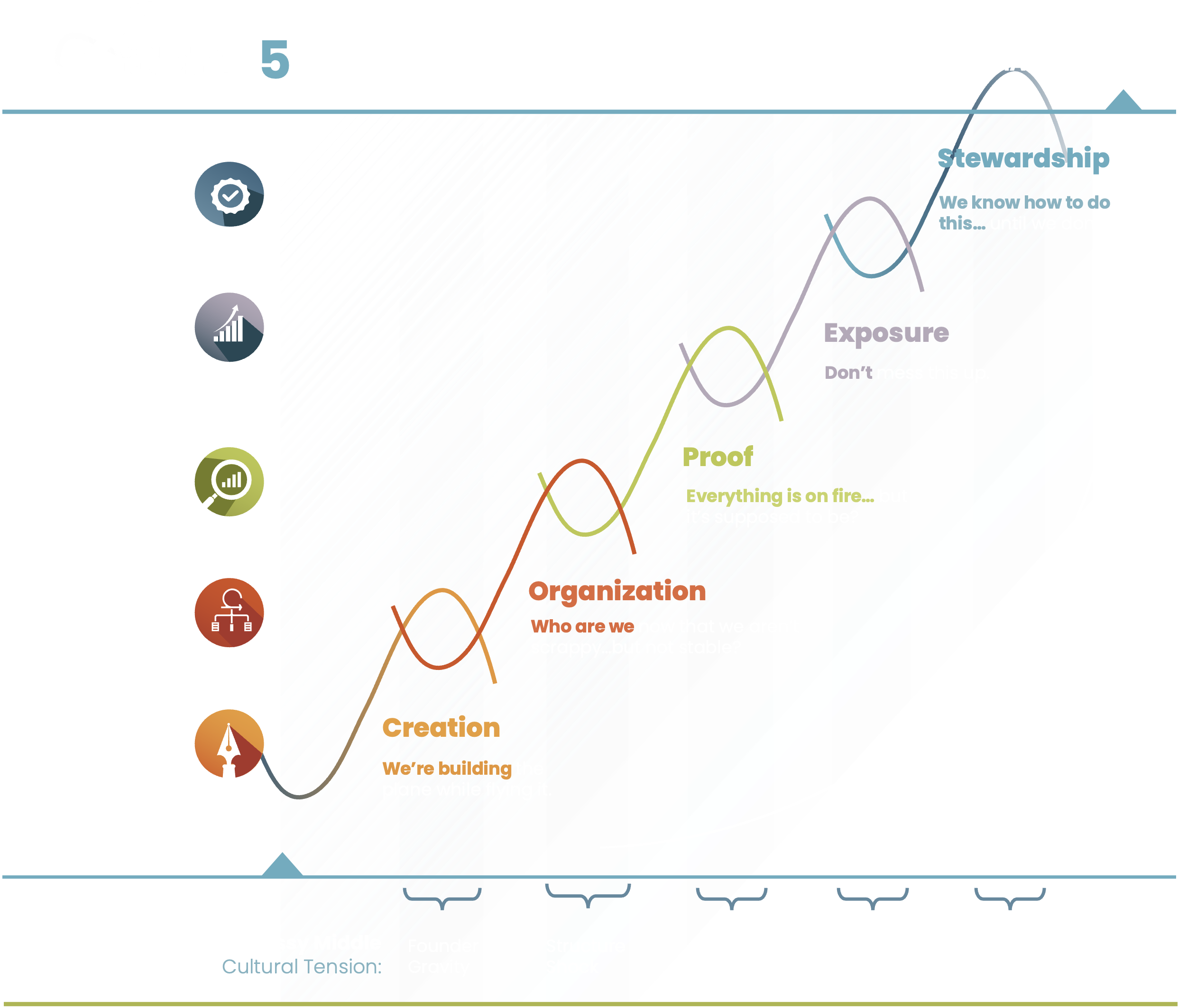
It serves to guide leaders through understanding the predictable people dynamics that accompany each stage of growth—and to lead them intentionally rather than reactively. And it provides a grounded, human-centered lens for navigating them without compromising excellence. That is the difference between surviving growth (or possible death) and jumping the curve.
What’s Coming Next
In the coming weeks, we’ll explore:
Each stage in depth
The messy middle between curves
Why decline shows up even when the science is succeeding
Early signals it’s time to evolve
Moves leaders can jump the curve without burning out their teams
What it really takes to scale culture alongside operations
Our aim is simple:
To make the human side of life sciences growth visible, speakable, and leadable.
Because once leaders understand the journey and the tools they need to lead it, everything becomes easier to navigate.
Stay tuned for more articles, webinars, tools, and resources to support Life Science leaders through their growth journey!
We’re looking forward to continuing the conversation!
Morgan Daniels & Wendy White