
The Messy Middle: Why Growth in Life Science Organizations Feels Hard Even When Things Are “Working”
Every growth curve has a natural lifespan. What once worked beautifully eventually begins breaking under new complexity, scale, or regulatory pressure.
Ambiguity and pressure peak. Energy disperses. Communication gets heavier. Decisions slow down. Misalignment weighs on teams. The air just feels different.
These aren’t signs of failure, rather natural tensions of growth – You’ve entered the messy middle.
The messy middle is the unavoidable space between one growth curve and the next—where the ways of working that got you here begin to strain, but the new ways required for what’s next aren’t fully formed yet. Performance still matters. Delivery still matters. And at the same time, the organization is being asked to change while the workforce is juggling operating in two realities simultaneously.
The messy middle rarely announces itself loudly. Often, by the time the tension feels obvious, the culture has already absorbed weeks and months of strain and is already a risk. Signals you may start to feel -
Everything is technically “fine,” but nothing feels easy
Leaders solve the same problems repeatedly
Teams feel stretched thin and work around each other, versus with each other
There’s a quiet sense of wobble
The messy middle is unavoidable. But suffering through it is not. Through our 30 years working with life science organizations, we’ve learned it is expected, predictable, and navigable—when you know what you’re looking at.
Below, we walk through how the messy middle shows up across each stage of the life sciences growth journey—and the core cultural tensions leaders must intentionally lead through to successfully jump to the next curve.
Every growth curve has a natural lifespan. What once worked beautifully eventually begins breaking under new complexity, scale, or regulatory pressure.
Ambiguity and pressure peak. Energy disperses. Communication gets heavier. Decisions slow down. Misalignment weighs on teams. The air just feels different.
These aren’t signs of failure, rather natural tensions of growth – You’ve entered the messy middle.
The messy middle is the unavoidable space between one growth curve and the next—where the ways of working that got you here begin to strain, but the new ways required for what’s next aren’t fully formed yet. Performance still matters. Delivery still matters. And at the same time, the organization is being asked to change while the workforce is juggling operating in two realities simultaneously.
The messy middle rarely announces itself loudly. Often, by the time the tension feels obvious, the culture has already absorbed weeks and months of strain and is already a risk. Signals you may start to feel -
Everything is technically “fine,” but nothing feels easy
Leaders solve the same problems repeatedly
Teams feel stretched thin and work around each other, versus with each other
There’s a quiet sense of wobble
The messy middle is unavoidable. But suffering through it is not. Through our 30 years working with life science organizations, we’ve learned it is expected, predictable, and navigable—when you know what you’re looking at.
Below, we walk through how the messy middle shows up across each stage of the life sciences growth journey—and the core cultural tensions leaders must intentionally lead through to successfully jump to the next curve.
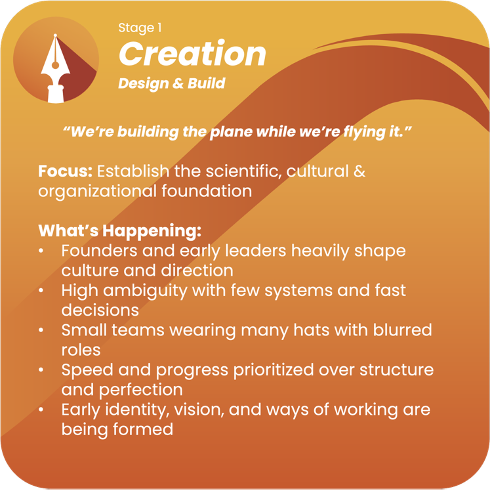
Stage 1: Creation
During the early parts of the stage the entrepreneurial energy dominates. There is no robust workforce – only a few early leaders, wearing many hats as they begin to shape an organization. Everything feels urgent and formative. And it is.
At first, it feels exhilarating. You are inventing something new, and the future feels expansive. Over time as momentum builds, something shifts.
The messy middle cultural tension point – founders gravity.
The messy middle appears when the very behaviors that enabled early progress begin to strain under growth – especially as you scale up staffing.
Startup ways of working collide with the needs of the emerging workforce and structure required to run the organization
Informal decision-making becomes harder as teams and complexity increase
Founders struggle to shift from doing everything to enabling others
Informal systems become structural defaults
Tension rises between speed and the discipline required in regulated environments
Most leaders underestimate just how formative this stage is. This is the time where cultural DNA forms, leadership patterns take root and silent trade-offs begin. Jumping the curve here is about designing just enough scaffolding to hold growth — without suffocating innovation – as you move from improvisation to intentional operations.
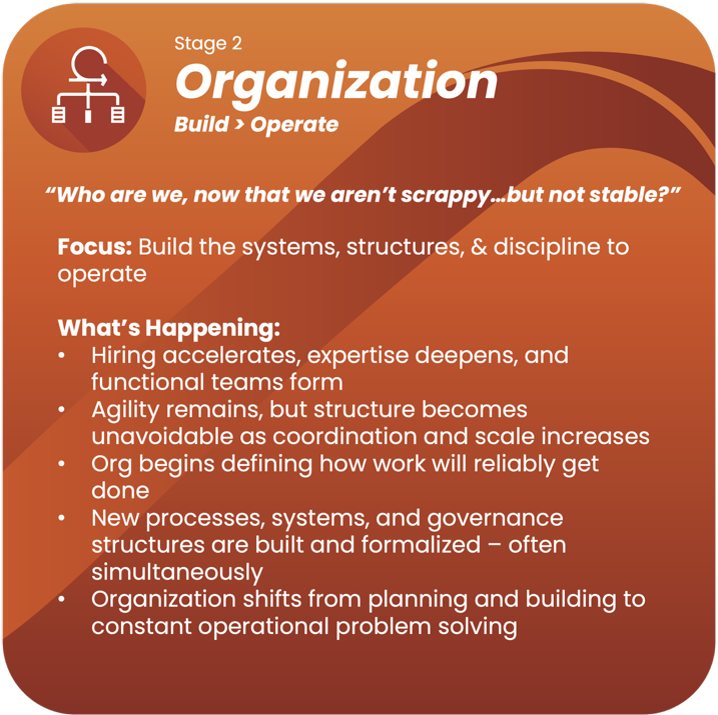
Stage 2: Organization
Stage 2 is where the organization evolves from pure possibility to emerging complexity. The scrappy, fast-moving culture that made the company successful in its earliest days begins to collide with the realities of operating in regulated environments with a larger workforce. Leaders and teams that were once united by the energy of creating something new now face a different question: How do we run this — every day, consistently, and compliantly?
The messy middle cultural tension point –structure shock
The messy middle here lives in the tension between autonomy and control.
Governance introduces clarity—but also frustration and perceived bureaucracy
Processes that looked good on paper struggle under real-world volume
Cross-functional coordination becomes harder as dependencies grow
Early builders clash with newly hired experts
Role confusion and shifting authority slow decisions and create rework
Leaders often feel pulled in two directions: Move faster and be more disciplined—at the same time. For early leaders, this cultural transition can feel restrictive toward what drew them to the organization in the first place. Without intentional leadership, structure shock can erode trust, alignment, and momentum instead of enabling scale.
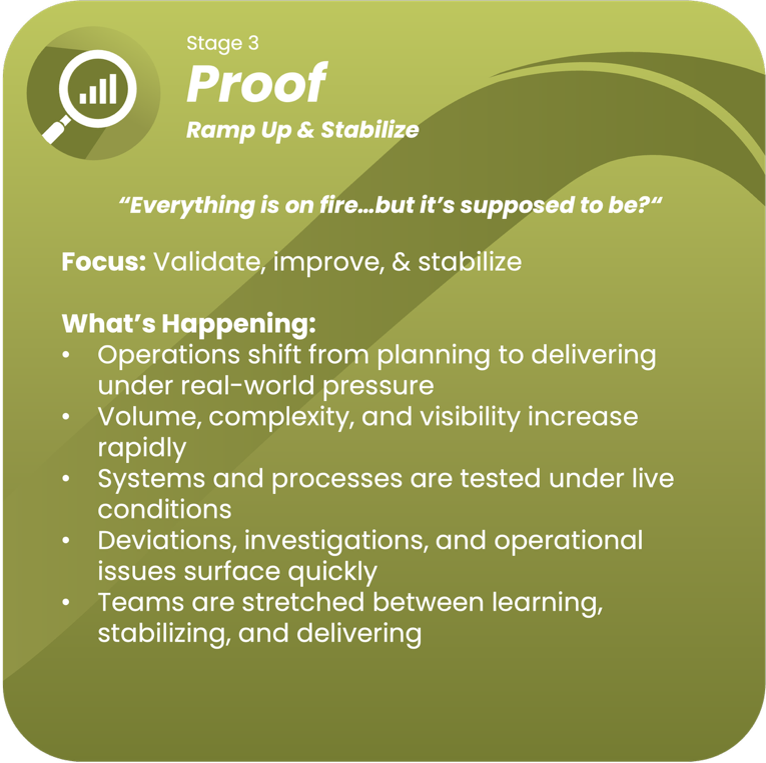
Stage 3: Proof
Stage 3 is when the organization stops preparing to operate and actually begins operating under real pressure. Volume, complexity, and visibility increase rapidly. What once existed as plans, SOPs, and operating models now meets the unpredictable reality of day-to-day execution. Conflicts and tension rise as teams are stretched between, learning, adapting, firefighting, and delivering.
The messy middle cultural tension point –blame.
As pressure mounts, the messy middle shows up in how the organization responds to problems.
Firefighting and heroics crowds out structured problem-solving
Burnout and fatigue quietly normalize
Cross-functional breakdowns create confusion, conflict and mistrust
Small issues cascade quickly across timelines and teams
Learning slows as survival becomes the priority
Blame cultures don’t usually start with bad intent. It emerges when people feel overwhelmed, exposed, and out of time. The leadership challenge here is not eliminating problems—but clearly prioritizing, empowering their teams, and managing energy and output under pressure.
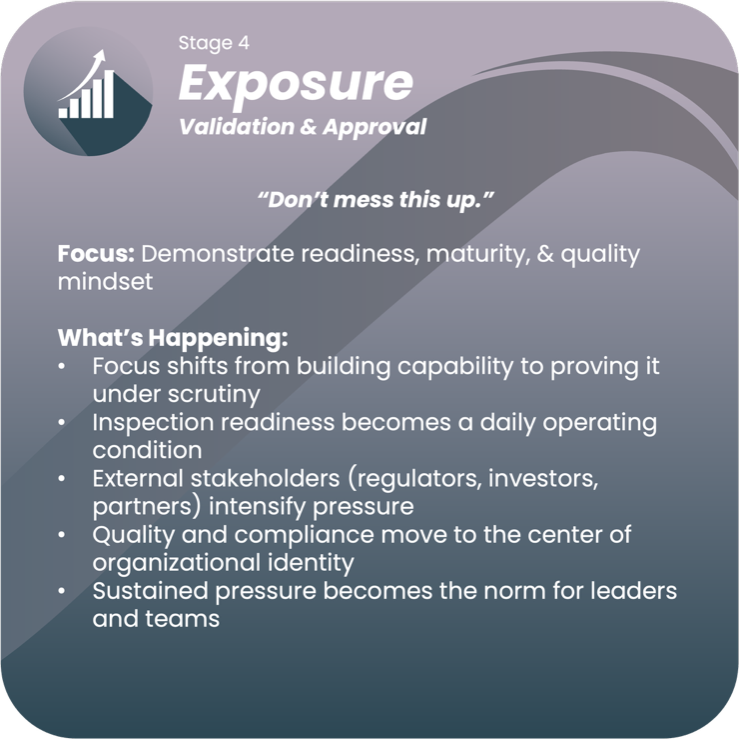
Stage 4: Exposure - Validation & Approval
Stage 4 is when the organization faces the most exposure. External validation, inspections, approvals, and scrutiny now shape daily decisions. What was once internal problem‑solving is suddenly visible to regulators, investors, partners, and boards. Expectations are high, errors and consequences feel severe, and recovery time is limited. The stakes are at an all-time high and internal pressure hits its peak.
The messy middle cultural tension point – fear.
The messy middle emerges as the organization shifts from building capability to proving it—under sustained scrutiny. The systems may be largely in place, but the human response to exposure begins to reshape behavior.
Leadership pressure cascades through the organization, amplifying stress at every level
Risk aversion increases as mistakes feel more costly and more visible
Teams struggle to separate signal from noise amid constant data, requests, and inspections
People begin to self‑protect—hesitating to surface uncertainty, concerns, or bad news
Communication narrows, alignment frays, and decision‑making slows under sustained pressure
The leadership challenge in Stage 4 is not enforcing more control or driving harder. It is guiding the organization to hold its nerve—maintaining clarity, deep alignment, and trust while under observation. Jumping the curve here requires leaders to deliberately counter fear with steadiness: reinforcing purpose, protecting transparency, sunshining challenges, and ensuring that quality is driven by ownership and pride—not avoidance.
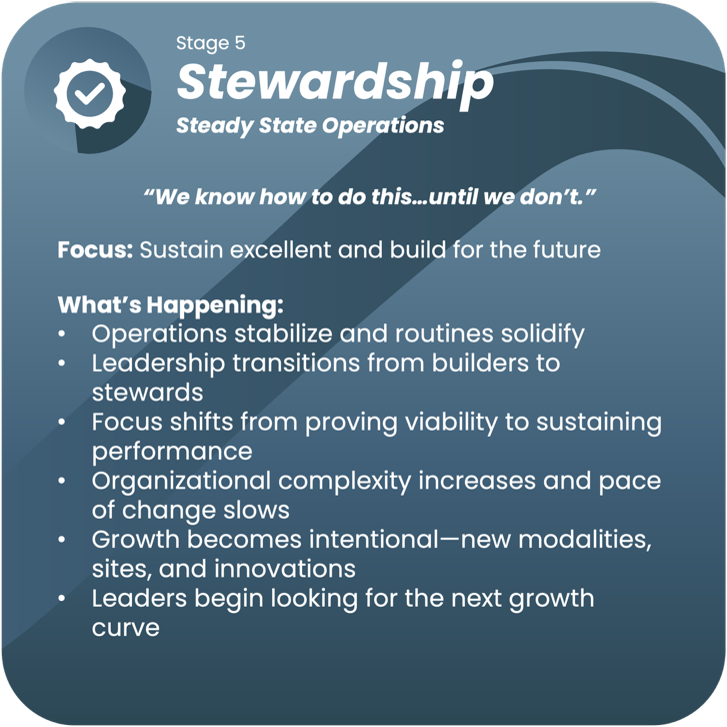
Stage 5: Stewardship — Steady State Operations
By Stage 5, organizations have moved beyond viability and experiences a different kind of growth — not expansion at all costs, but optimization, reliability, sustainability, and strategic renewal.
Systems mature and performance becomes more reliable. Leaders make the transition from builders to stewards. From the outside, things look “done.” However, red tape expands, innovation dips, and complacency emerges.
The Messy Middle: Bureaucratic Drift
Even in stability, a messy middle exists, as what has once made an organization successful will eventually decline with time.
Operational success creates resistance to change
Years of pressure lead to quiet burnout
Processes accumulate and slow decisions
Continuous improvement is expected—but experimentation feels risky
Without renewal, success slowly becomes stagnation
The danger here is focus, adaptability, and drive begin to shift to drift, rigidness, and complacency. All growth eventually hits decline without innovation. Leaders must continue squinting into the future for the next growth opportunity – new modalities, sites, and innovations – while continuing to motivate and engage their staff along the way.
Why Understanding the Messy Middle Matters
The messy middle isn’t a sign that something is broken. It’s a signal that growth is demanding evolution.
Most organizational crises do not appear suddenly. They emerge gradually through signals that are easy to miss in busy and break speed environments. Leaders who learn to recognize these signals early are better able to guide their organizations through the next curve, without losing the engagement and commitment of the workforce along the way.
When leaders name it:
Teams stop personalizing stress and tensions become openly discussed
Energy shifts from blame to problem-solving
Leaders can intentionally jump moves—evolving culture, leadership behaviors, systems, and ways of working to meet what’s next
Organizations can predict when, where, and why they’ll occur in the future, and be proactive.
There is a powerful advantage in recognizing where you are, understanding what is to come—and leading accordingly.
Growth is human – and leading through the messy middle with intention can be essential for survival.
Stay tuned over the next few weeks as we go through each stage in more depth – elaborating on why these messy middles emerge and the jump moves you can make to navigate to your next stage of growth.